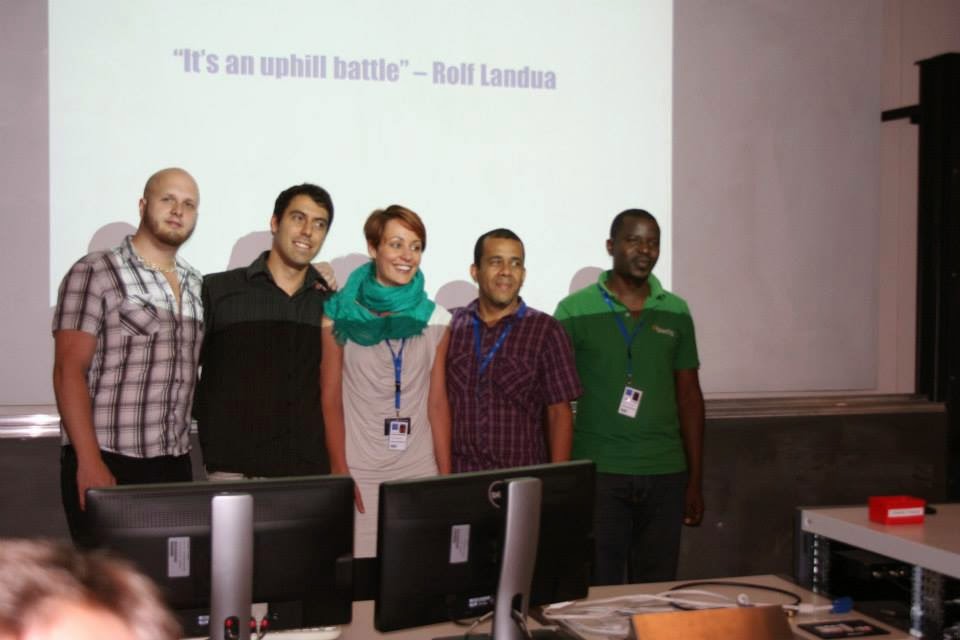
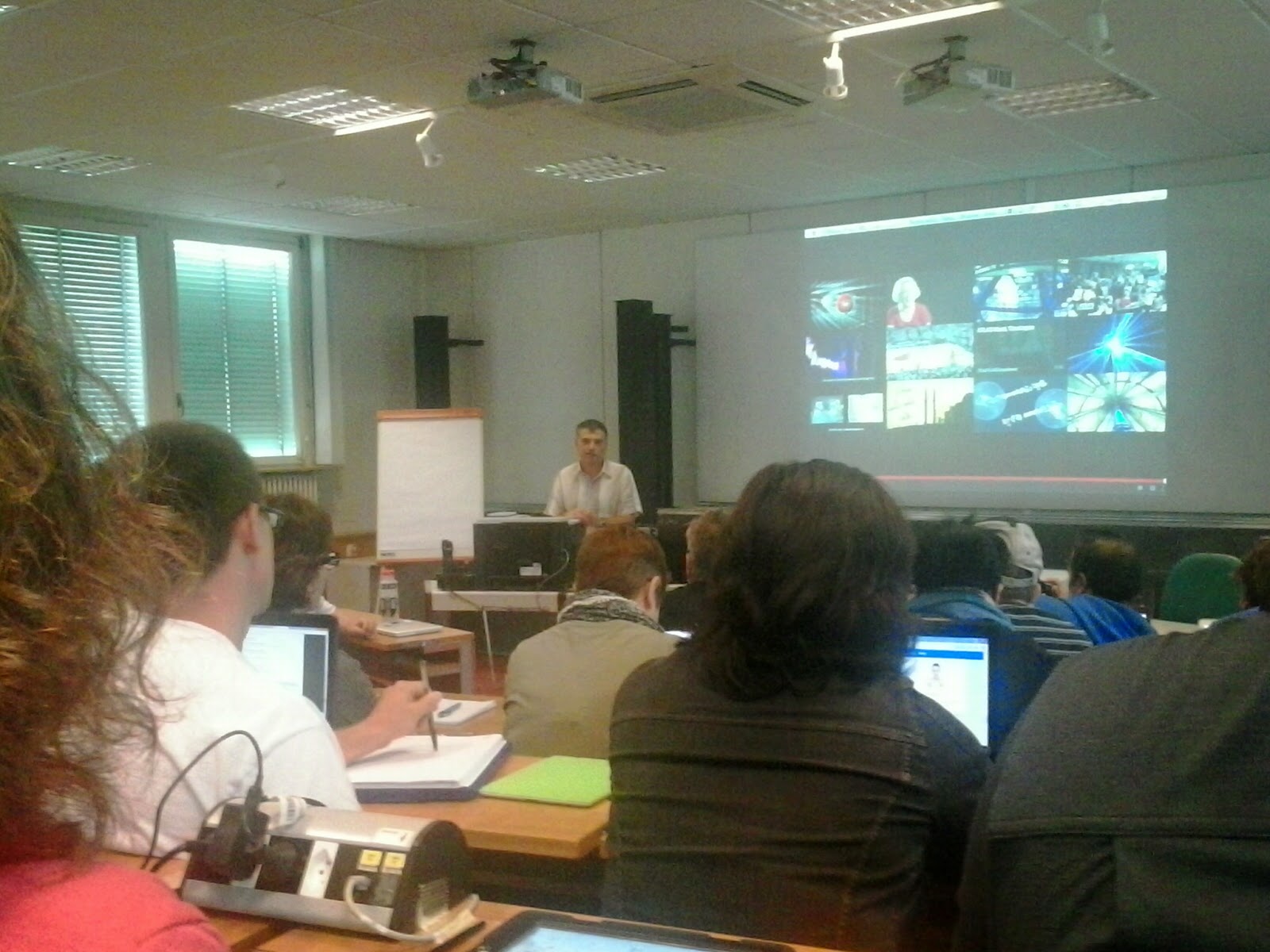
Meanwhile, some people are working hard in their presentation for tomorrow.
In the afternoon, a pretty interesting Question & Answer Session with Michelangelo Mangano: quark-gluon plasma state, black holes, hidden dimensions, geometry of space-time,...
Thank you very much for your time and your explanations.
7.45 a.m. My alarm clock wakes me up again. After the International evening, today is going to be hard. I've just checked the agenda on my phone: lectures in the morning and visits in the afternoon, as usual.
9.00. Rolf Landua talks about CERN and education. Here you can read how to arrange a visit with your students.
10.00. Kate Shaw talks aboutIPPOG (International Particle Physics Outreach Group) that organizes masterclasses to high-school students from all over the world. This event takes place every year in March at a local University and consists in introductory lectures, analysis of real LHC data and an international video conference with CERN.
11.00. Steven Goldfarb from University of Michigan talks about the role of communication in science and the goals of the Outreach Department, that are focussed mainly in atract and retain the next generation of scientists and science educators.
He is showing us resources from the outreach platform, such as ATLAS virtual visit or hangouts with CERN every Thursday at 17.00.
11.45. Julia Woithe from Universitaet Kaiserslautern talks about CERN S'cool lab, which was officially inaugurated on July 3rd, 2014. Lots of experiments can be done here such as, Rutherford's experiment, measurement of Planck's constant or cosmic ray detection using a cloud chamber.
Look at this video: S'Cool Lab: the complete story.
In the afternooon two visits: COMPASS (COmmon Muon Proton Appararus for Structure and Spectroscopy) and ALICE (A Large Hadron Collider Experiment)...
COMPASS experiment is located at surface. We can see its different layers unlike the other four main detectors.
The aim of COMPASS experiment is to investigate how quarks and gluons interact to give particles we observe.
Nearly 240 physicists from 13 countries and 24 institutions work in COMPASS experiment.
Going underground again to visit ALICE.
ALICE experiment studies gluon-quark plasma, a state of matter that was formed just after the big bang.
ALICE detector is 26m long, 16m high and 16 wide.
Waiting for the bus to come back CERN.
... and in the evening the third lecture about History of scientific ideas in western culture by Gron Jones.
9.00 a.m. Lecture about Physics Education 2.0 by Jeff Wiener from University of Viena.
And then, It was the time to work in our project...
Discussing our progress with Rolf.
In the afternoon, we had a tour to LHCb experiment which is designed to study the difference between matter and antimatter and shed light on why matter survived to build our universe.
LHCb involves 689 scientists from 48 institutes around the world.
The aim of this experiment is to record the decay of B-mesons (b an anti b quarks)
What a nice surprise while having
breakfast! Jack Steinberger, Nobel Prize in Physics in 1988
for co-discovering the muon neutrino, is sitting behind us.
Steinbergerg joined CERN in 1968. Although he is retired since 1986, he comes here frequently.
I've just checked the agenda. Today is
going to be awesome and very, very long: several lectures and two
visits.
At 8.30 a.m. , lecture about Physics at LHC by Michelangelo Mangano from CERN.
M. Mangano created in 1998 CERN's High School Teacher Programme. Thank you, sir!
J. Incandela is the spokesperson on the CMS experiment at the LHC.
While having lunch...
Meeting: working group 4.
And then what I've been expecting
since this morning: lecture about Cosmology and dark energy by
Jonathan Ellis from CERN, a British theoretical physicist who was
awarded the Maxwell Medal in 1982 and the Paul Dirac Prize in 2005 from the Institute of Physics.
Ellis is frequently invited to give public lectures on
particle physics and cosmology.
9.00 a.m. Lecture about Computing at CERN by Tim Smith from CERN/IT.
The huge volumen of data produced at CERN represents considerable challenges such as, storage system, data exchange or data processing. Using the Worldwide LHC Computing Grid, which is a global collaboration of computer centres, it is posible to store, distribute and analize all this information.
Then, we've visited the CERN Data Centre that houses servers and data storage systems.
Phat Srimanobhas from Chulalongkorn University
After having lunch, a lecture about Physics beyond the Standard Model by Gian Giudice from CERN: Higgs field, Inflation theory, gravitational waves, gauge symmetry, GUT, hidden dimensions,...
9.00 a.m. Lecture about Antimatter in space and on earth by Michael Doser from CERN.
We've learnt what antimatter is, when it was predicted and detected for the first time, how many antiprotons are produced at CERN every year and its current and future aplications.
After this introductory lecture, we've been visiting the Antiproton Decelerator (AD) which is a sort of factory capable of providing low-energy antiprotons in order to study antimatter.
Several activities on today's agenda. Our brains are about to burst. We almost see muons and pions everywhere. Luckily, the weekend is right here. Two days to restore our software. Great!.
In the afernoon, a rewarding lecture about Particle Physics in the 21st Century by Rolf Landua.
We've been dicussing about dark matter, dark energy, supersymmetrical particles, string theory,... A lot of thoughts and concerns. Within the next two weeks I'm so sure we will clear up doubts.
Last but not least, an evening party outside restaurant 1.